Lately been building an astrological library, ourania, for personal electional work, charts, and other space-weather exploration. The motivation is two-fold: I would like a space-weather library that operates how I think, and I want to increase and operationalize astro-knowledge. The process is turning into a theme that Kevin Cann articulates in Platonic Surrealism[1] and other works: the writing writes the writer. Getting the computation right, attending to what the tradition actually says — this is how I become capable of using it. The doing is the learning.
I've also recently been reading Ani.Mystic, Gordon White's account of animism as a living practice (Scarlet Imprint)[2], and have reclaimed enough personal time to be RSPM once again; the value of which is beyond words. Chapter 5 describes Austin Coppock's rainmaking election during the 2019 Tasmanian bushfires.
The obvious move was to try to reconstruct it.
In early 2019, Gordon White's farm in the Huon Valley, Tasmania, was burning. The summer had been the driest in the state's recorded history — January delivered less than a tenth of normal rainfall at nearby stations, conditions the Bureau of Meteorology would later describe as "about one-fifth of average" statewide. Austin Coppock, working at a distance in the United States, was asked to find a moment for a group rainmaking ceremony.
This is a reconstruction of that election — the animist reasoning behind it, what the Western sky had to offer and didn't, and what the instrumental weather record says happened five days later.
Who Has Jurisdiction?
An animist electional astrologer approaching a fire emergency doesn't open an ephemeris and ask what configuration is most dignified. The question is different: which entities have jurisdiction over this situation, and when can I reach them?
The cosmological frame Austin was working within treats nakshatras — the 27 lunar mansions[3] of the Vedic sky — not as abstract divisions but as inhabited territories. Each mansion is presided over by a deity with a specific character and domain. The Moon's passage through a mansion is a window of access. The election is a threshold. The astrologer's job is to find the right threshold in time, given what time there is.
Candidate Mansions
Scanning the nakshatra belt for a rain election from late January 2019, a practitioner would identify several mansions by elemental affinity, presiding deity, and critically, how soon the Moon would arrive.
Śatabhiṣā, the 24th nakshatra, ruled by Rāhu, presided over by Varuṇa — the Vedic lord of the cosmic ocean, of rivers, rain, and the oaths that bind the seasons. He is the tradition's most obvious rain deity. His mansion was the conventional answer. It was available around February 6–7. The farm might not be standing by then.
Pūrvāṣāḍhā, the 20th nakshatra, arrived first. The Moon would enter it at 2:37 AM on Saturday, February 2 — four days sooner. Its presiding deity is Āpas, the primordial goddess of water. Its associated Nāgarāja is Vāsuki, king of the water serpents.
The choice, when the farm is burning, is not difficult.
Āpas, Not Varuṇa
Varuṇa governs rain as a cosmic lawmaker. He controls the monsoon, ratifies the seasons, enforces the ṛta — the order of things. Petitioning Varuṇa is asking the water-bureaucracy to act. Āpas is the water. The shakti of Pūrvāṣāḍhā is to invigorate and cleanse — not to permit, not to authorize, but to move through.
In a situation of emergency, that distinction matters.
Vāsuki
Nāgas are creatures of the earth, the groundwater, the underworld rivers that sustain the world from below. Across virtually every strand of Indic mythology, the relationship between Nāga and Garuḍa — serpent and eagle, water and fire, the deep and the drying wind — is the relationship between natural adversaries. Garuḍa is the fire-bird. Vāsuki is fire's ancient opponent.
Calling Vāsuki into a bushfire emergency is not a rain petition. It is a summoning of fire's natural enemy into the situation — an older, more specific kind of relation than cosmic administration.
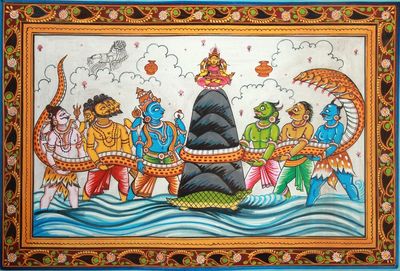
His mythology goes further. In the Samudra Manthan[4], the churning of the cosmic ocean, Vāsuki served as the churning rope: the entity through whose body the transformation of sea into amṛta was accomplished. He has already participated in the transmutation of water into life-giving substance. When you call him into a dying landscape, you are calling something that knows how that process works from the inside.
The Land
Austin was working from the United States. The farm was in the southern tip of Tasmania.
Across Australia, in forms varying by language and country, the Rainbow Serpent is the water-creation being: a great serpent whose domain includes sky-waters, rivers, seasonal cycles, and the maintenance of living country. In drought and fire, it is that serpent's relation to the land that the practitioner is working to restore.
No claim of literal equivalence is made between Vāsuki and the Rainbow Serpent. The point is subtler. A practitioner who takes local spiritual sovereignty seriously would understand that a serpent-water-fire archetype was not being imported into empty ground. The Vedic frame opened the timing channel. Who was listening in the Huon Valley in February 2019 was a question the nakshatra system doesn't answer — and the answer was shaped as much by the land as by the sky.
What the Western Frame Offered
When Austin turned to the Vedic system, he had already worked through the Western inventory. The nearest water sign — Moon in tropical Pisces — was approximately four days away. Cancer was two weeks away; Scorpio, three.
The Western mansion system (the manazil al-qamar, entering medieval Europe via Picatrix) places the Moon in Mansion 23 at the election time — Sa'd al-Bula, traditionally associated with the flight of captives and the escape of thieves. A Saturn-zone mansion, suited to liberation and recovery, not rain.
There was a quieter Western signal available. At 1:45 PM on February 2, the Moon was applying sextile to Neptune, perfecting approximately two hours later. Neptune governs the sea and dissolution in the modern tradition; the aspect is harmonious. Whether Austin noted it as confirmation or it was implicit in the chart is unknown. But it reads as the Western sky corroborating, in its own register, what the nakshatra had already identified.
The ayanamsha gap — the roughly 24° difference between tropical and sidereal coordinates — is exactly what separates these two readings. That gap placed the Moon in the Saturn zone by Western reckoning, and in the heart of a water mansion by Vedic.
1:45 PM
The nakshatra window opened at 2:37 AM. The election was called for 1:45 PM — nearly eleven hours later.
In classical electional astrology, the day is divided into planetary hours, each assigned in the Chaldean order from the planet ruling the day. Saturday is Saturn's day. At approximately 43°S in early February southern-hemisphere summer, each hour runs about 71 minutes. The 7th daytime hour — the Hour of the Moon — runs from approximately 1:27 to 2:38 PM AEDT.
At 2:37 AM when the Moon entered Pūrvāṣāḍhā, it was the Hour of Mercury. The convergence of Moon-in-water-mansion and Moon's-own-hour was not available at the window's opening. It arrived in the afternoon.
The reasoning is threefold: Moon in Pūrvāṣāḍhā, the mansion of Āpas and Vāsuki; Hour of the Moon, when lunar influence over water and moisture is traditionally heightened; and full afternoon daylight for a group ceremony on a farm under active fire threat. 1:45 PM places the ceremony about 18 minutes into the Moon's hour — inside its domain, clear of the Mercury/Moon boundary, with practical buffer for coordination and calculation tolerance.
What Happened
The ceremony took place at 1:45 PM AEDT on Saturday, February 2, 2019. Heavy rain arrived Thursday morning, February 7.
February 7 is the anniversary of Tasmania's catastrophic 1967 fires.
The Bureau of Meteorology's instrumental record is precise on this point. Geeveston station (094137), closest to the Huon Valley, recorded 23.6 mm on February 7. Hobart (Ellerslie Road) recorded 26.2 mm — matching, to the millimetre, the figure White cites from the farm's own weather station. BOM documented twenty millimetres in less than two hours on the morning of the 7th and confirmed the start of a persistent westerly pattern: "Westerly winds and cold fronts were prevalent during February, especially from the 7th to the 14th."
The light rainfall described for the days between the ceremony and the main event — February 2 through 6 — is not reflected in valley station records, which show 0.0 mm across those days. The farm sits above the valley floor; localised orographic drizzle is physically plausible without appearing in gauge readings below. The discrepancy is worth noting.
The core of the account holds precisely. January 2019 was Tasmania's driest January on record — Hobart recording less than 1% of its monthly average. An historically unprecedented drought, followed by a cold-front event delivering approximately 26 mm on a specific Thursday, which ended the immediate fire crisis. Multiple independent sources confirm the February 7–14 rain as the turning point. The text, if anything, understates the severity of what preceded it.
The tropical Pisces window Austin had initially identified arrived Wednesday, February 6. Rain began that same night, with the Moon-in-Pisces window coinciding with the final days of the wet period. Both timing systems were ultimately active. The nakshatra timing was the one available in time.
Kevin Cann, Platonic Surrealism: A Modern Framework for Meaning Beyond Science and Religion (Platonic Surrealism Press, 2025). ↩︎
Gordon White, Ani.Mystic: Encounters with a Living Cosmos (Scarlet Imprint, 2022). ↩︎
Wikipedia, "List of Nakshatras," https://en.wikipedia.org/wiki/List_of_Nakshatras ↩︎
Featured image: artist unknown, Eastern Ganga period (c. AD 1110–1435), Odisha; Patachitra or Odishan manuscript painting tradition. Original institutional source unconfirmed; reproduction distributed by Tallenge. ↩︎